
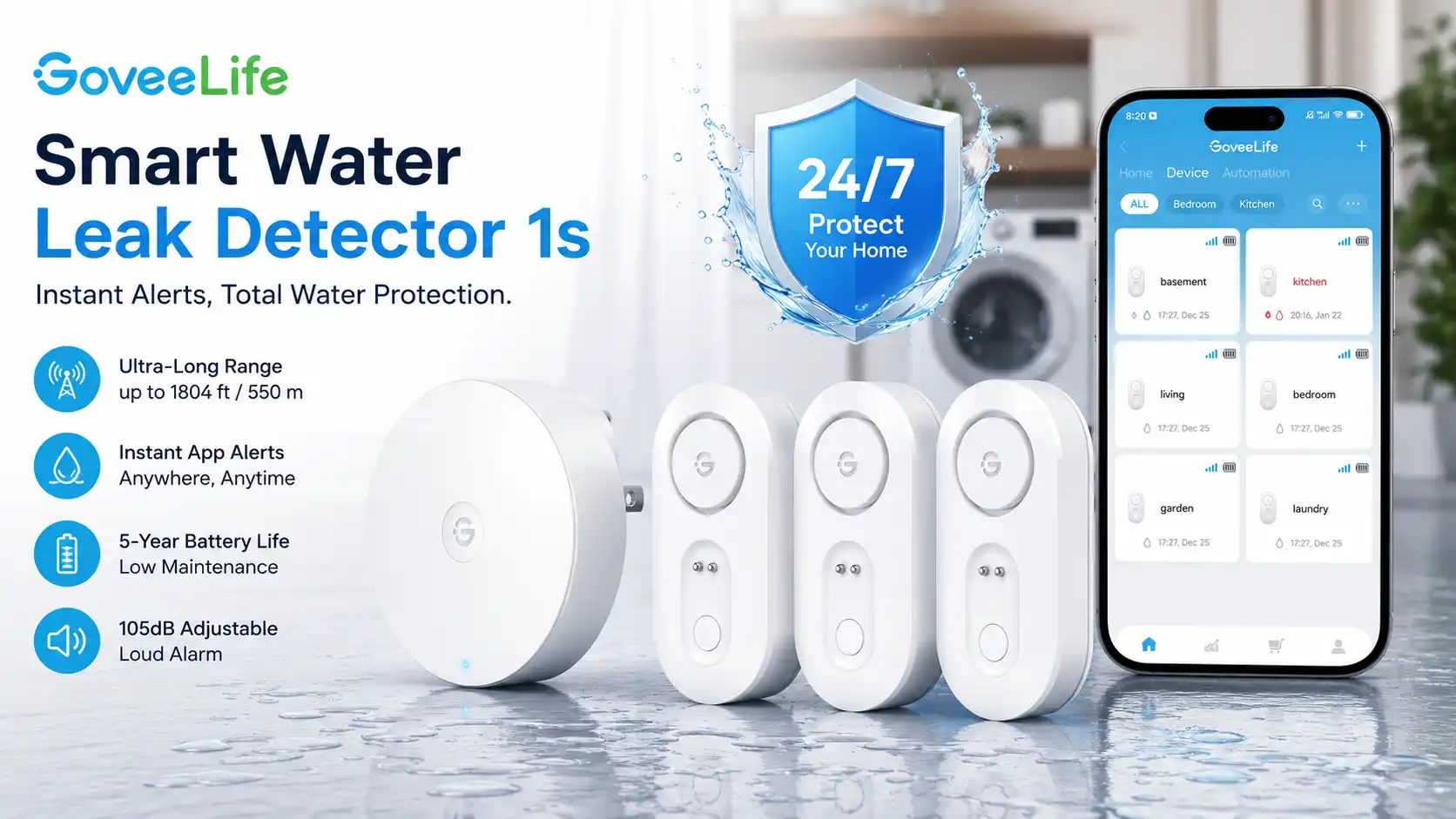
A long-range WiFi water sensor with a 5-year battery and smart app alerts — built for large homes, basements, and hard-to-reach spots where ordinary detectors fall short.
Introduction
A slow leak under the kitchen sink or a flooding sump pump in the basement can cause thousands of dollars in damage before anyone notices — especially in unoccupied areas of the home. Standard plug-in water detectors solve the audible alarm problem, but they do nothing if you’re not home to hear it. And most WiFi-based sensors rely entirely on your router’s signal, which can be unreliable in detached garages, deep basements, or outbuildings far from the house.
The GoveeLife Upgraded Smart Water Leak Detector 1s (model H5059, paired with the H5044 gateway) takes a different approach. It uses Sub-1G wireless technology — the same low-frequency band used in some industrial sensors — to maintain a reliable connection up to 1,804 feet through walls, well beyond what standard WiFi or Bluetooth sensors can manage. The result is a system that covers large and sprawling properties while still delivering smartphone alerts via SMS, email, and the GoveeLife app. It’s a meaningful step up from entry-level detectors, but it comes with ecosystem requirements worth understanding before you buy.
GoveeLife H5059 (sensor) + H5044 (gateway)
Up to 1,804 ft (550m) through 5 walls
Sub-1G (915MHz)
105dB, 4 adjustable volume levels
Up to 5 years (built-in, no installation required)
IP67
SMS, email, app push notification, audible alarm, Alexa
2.4GHz only (gateway connects to WiFi; sensor connects to gateway)
Dual sets
H5044 only (not compatible with H5040 or H5043)
Key Features
Sub-1G Long-Range Wireless Technology
Most WiFi water sensors communicate directly with your router, which means signal quality degrades quickly over distance or through thick concrete walls. The H5059 sensor communicates with the H5044 gateway over a Sub-1G (915MHz) frequency instead, which is considerably better at penetrating walls and traveling long distances. The claimed range is 1,804 feet through up to five dense walls. In practice, results will vary based on your specific construction and layout, but this is a genuine architectural difference — not just a marketing claim — compared to standard 2.4GHz or Bluetooth sensors. For multi-story homes, detached structures, or properties with thick masonry walls, the range advantage is real and meaningful.
5-Year Battery Life with IP67 Waterproof Rating
Battery maintenance is one of the most common reasons people stop trusting their leak detectors. Most competing sensors need replacement batteries every one to two years. GoveeLife rates these sensors at five years on a single built-in charge, which significantly lowers the ongoing maintenance burden. The IP67 waterproof rating adds durability in environments where moisture is constant — near dishwashers, under sinks, or in damp basements. The battery is built into the device and arrives pre-charged, so there’s no initial setup battery hassle. The tradeoff of a non-replaceable battery is worth noting: when the sensor eventually reaches end-of-life, the whole unit will need replacing rather than just swapping cells.
Multi-Channel Smart Alerts with App Control
When water is detected, the sensor flashes red and triggers the 105dB audible alarm while simultaneously pushing alerts through SMS, email, and the GoveeLife app. This multi-channel approach matters because any single alert method can fail — phones can be silenced, emails can be missed, and you might simply be too far to hear the alarm. Having all three fire at once significantly improves the odds that someone gets the message quickly. The app also lets you silence the alarm remotely with a single tap, adjust volume to one of four settings, and add multiple email addresses so family members or property managers also receive notifications. Alexa integration is supported for voice-based status checks.
Design and Build Quality
The H5059 sensor is compact and white, designed to sit flat on floors or surfaces near water-prone appliances. The dual probe design — with two sets of sensor contacts — improves detection reliability compared to single-probe models; if one contact is slightly elevated due to floor unevenness, the second has a better chance of making contact with water. The IP67 waterproof rating means the device itself can handle the wet conditions it’s designed to detect, and can be wiped dry and reused after triggering.
The H5044 gateway is a separate unit that plugs into your home’s WiFi network and acts as the communication hub. It’s the piece that needs to be connected to 2.4GHz WiFi — the sensors themselves don’t need WiFi at all, just proximity to the gateway within the Sub-1G range. The gateway supports only the H5059 (and H5830) sensors and is not backward-compatible with earlier GoveeLife gateway models. This is a firm limitation: if you already own the H5040 or H5043 gateway, it will not work with these sensors. The overall build feels appropriately utilitarian — these aren’t decorative products, and the design prioritizes function over appearance.
Performance
The core detection function — identifying standing water quickly and triggering an alarm — is where this sensor earns most of its praise. The dual-probe design and sensitivity to small amounts of water means it doesn’t require a significant flood to fire. The 105dB alarm is genuinely loud, comparable to a power tool or a truck horn at close range, and the four adjustable volume levels give you meaningful control depending on placement (a bedroom sensor at 2am shouldn’t be at max volume; a basement sensor probably should be).
The remote alert system is the product’s standout feature for most buyers. SMS notifications arrive quickly after detection, and the multi-recipient email feature is particularly useful for vacation properties or rental units where you’re not always on-site. App-based alarm silencing lets you acknowledge an alert and investigate without the alarm blaring continuously. The app’s “Find Device” function — which triggers a beep on misplaced sensors — is a small but genuinely useful practical touch.
One real-world caveat: the 1,804-foot range is a theoretical maximum in open air. Through five dense walls and across multiple floors with rebar-reinforced concrete, real-world range will be shorter. Most residential users in standard wood-frame homes should have no trouble covering the intended distances, but buyers in heavily insulated or steel-structured buildings should manage expectations.
Ease of Use
Setup requires the H5044 gateway, which connects to your 2.4GHz WiFi network through the GoveeLife app. The sensors are then paired to the gateway rather than directly to your WiFi, which simplifies sensor setup but adds a step compared to systems where sensors connect to the router directly. This gateway dependency is the most common friction point for new users — it’s a required component, not an optional upgrade. Buyers who purchase the standalone sensors (ASIN B0DQLDBXWF) without the gateway get a functional standalone audible alarm only; all smart features require the H5044.
Once setup is complete, daily use is largely passive — you place sensors, forget them, and act if an alert arrives. Volume adjustment via two quick presses of the sensor button works without the app, which is convenient for in-place tuning. That said, the gateway-only-supports-2.4GHz limitation can trip up users with 5GHz-only networks or mesh systems that merge bands automatically. Users should verify their router setup before purchasing.
How It Compares to Similar Products
The most direct comparison is the standard Govee WiFi Water Leak Detector, which connects sensors directly to your home WiFi without a gateway. That setup is simpler and cheaper upfront, but it’s limited by WiFi range and wall penetration. In a typical apartment or small home, the direct-WiFi approach works fine. In a large house, basement, or property with multiple outbuildings, the Sub-1G gateway approach of the GoveeLife 1s provides meaningfully better coverage.
The YoLink Water Leak Starter Kit uses LoRa (long-range) wireless technology for a similar use case — wide-area property coverage with a hub and multiple sensors. YoLink’s range claims are even larger, and it supports offline device-to-device triggers, which can be useful if your internet goes down. It’s a competing system worth comparing directly if you’re prioritizing maximum range and resilience. GoveeLife’s advantage is the tighter app ecosystem and multi-channel SMS/email alerts included at no extra service cost.
Budget standalone options like basic battery-powered water alarms (under $15 per unit) are fine for renters or people who are always home and just need an audible warning. They require no setup and cost very little. But they offer no remote alerts and no app control — a significant limitation for anyone who travels or wants peace of mind while away.
Pros & Cons
Pros
- Sub-1G technology delivers genuinely longer range than standard WiFi sensors, covering large homes and outbuildings
- 5-year battery life significantly reduces maintenance burden compared to most competitors
- Multi-channel alerts (SMS, email, app, audible) provide redundancy so notifications actually reach you
- IP67 waterproof rating means the sensor can handle the wet environment it’s designed for
- App alarm silencing and multi-recipient email make it practical for vacation homes and rental properties
Cons
- Requires the H5044 gateway for smart features — the standalone sensor sold under this ASIN does not connect to the app directly
- Gateway is only compatible with 2.4GHz WiFi, which can cause setup problems for users with 5GHz or automatic band-steering mesh networks
- Not compatible with older GoveeLife gateways (H5040, H5043), meaning existing Govee users may need to replace their hub
- Built-in non-replaceable battery means the entire sensor unit must be replaced when it eventually depletes
Who Should Buy This Product
This system is best suited for homeowners with large properties, multi-level homes, or outbuildings where WiFi coverage doesn’t reliably reach. It’s a strong choice for anyone who travels regularly, owns a vacation home, or manages rental properties — the SMS and email alerts mean you can be notified of a leak anywhere in the world, not just when you’re home to hear an alarm. The five-year battery life makes it especially practical for hard-to-access placement spots like under refrigerators, behind water heaters, or in crawl spaces. Anyone already invested in the GoveeLife H5044 gateway ecosystem will find the per-sensor cost quite reasonable when purchasing in multipacks.
Who Should Avoid This Product
Renters, apartment dwellers, or anyone in a small home with good WiFi coverage throughout probably don’t need the gateway-based long-range architecture here. A simpler direct-WiFi sensor (like the standard Govee WiFi Water Leak Detector) or a basic audible-only battery alarm will cover the use case at lower cost and with less setup complexity. Anyone running a 5GHz-only WiFi network or a mesh system without a separate 2.4GHz band should verify compatibility before buying — the gateway’s 2.4GHz requirement is a hard constraint. And buyers who already own an older GoveeLife gateway should check model compatibility carefully, as the H5059 sensor does not work with the H5040 or H5043 hubs.
Frequently Asked Questions
Can the H5059 sensor work without the H5044 gateway?
Yes, but only as a basic standalone audible alarm. Without the gateway, the sensor cannot connect to the app, send SMS or email alerts, or be remotely monitored. All smart features require the H5044 gateway. The gateway-plus-sensor kit is sold separately as a bundle (ASIN BB0DQLDBXWF).
Does my home WiFi need to reach the sensor’s location?
No — that’s the main advantage of this system. Only the H5044 gateway needs to be connected to your 2.4GHz WiFi router. The sensors communicate with the gateway over Sub-1G wireless, which can travel up to 1,804 feet through walls. You place the gateway near your router and the sensors anywhere within their Sub-1G range of the gateway.
How many sensors can one H5044 gateway support?
GoveeLife hasn’t published a specific maximum sensor count for the H5044 in the product listing, but the gateway is designed to work with multiple H5059 sensors simultaneously across a property. Buyers with large properties often purchase multipacks (3, 5, or 6 sensors) and pair all sensors to a single gateway.
Are the SMS alerts free, or do they require a subscription?
According to GoveeLife, SMS alerts are free regardless of how many times they are used — there is no subscription fee. Email and app push notifications are also included at no additional cost.
What happens if my internet goes down — will the sensor still alarm?
Yes. If your internet connection is down, the sensor will still trigger its 105dB audible alarm and flash red when water is detected. You will not receive SMS, email, or app notifications during an internet outage, but the local alarm function operates independently of your network.
Final Verdict
The GoveeLife Smart Water Leak Detector 1s solves a real problem that cheaper sensors ignore: maintaining reliable connectivity in large homes, basements, and outbuildings where WiFi doesn’t reach. The Sub-1G wireless architecture is a genuine differentiator, the five-year battery is a meaningful convenience upgrade, and the multi-channel alert system gives the kind of redundancy that actually prevents expensive water damage.
The gateway dependency and 2.4GHz-only WiFi requirement add setup complexity that may trip up some buyers, and the ecosystem lock-in (H5059 sensors only work with H5044 gateways) is a real consideration if you already own other GoveeLife hardware. But for the right buyer — a homeowner who needs broad property coverage and remote monitoring without wrestling with WiFi extenders — this system delivers solid value at a competitive per-sensor price, especially in multipacks.