
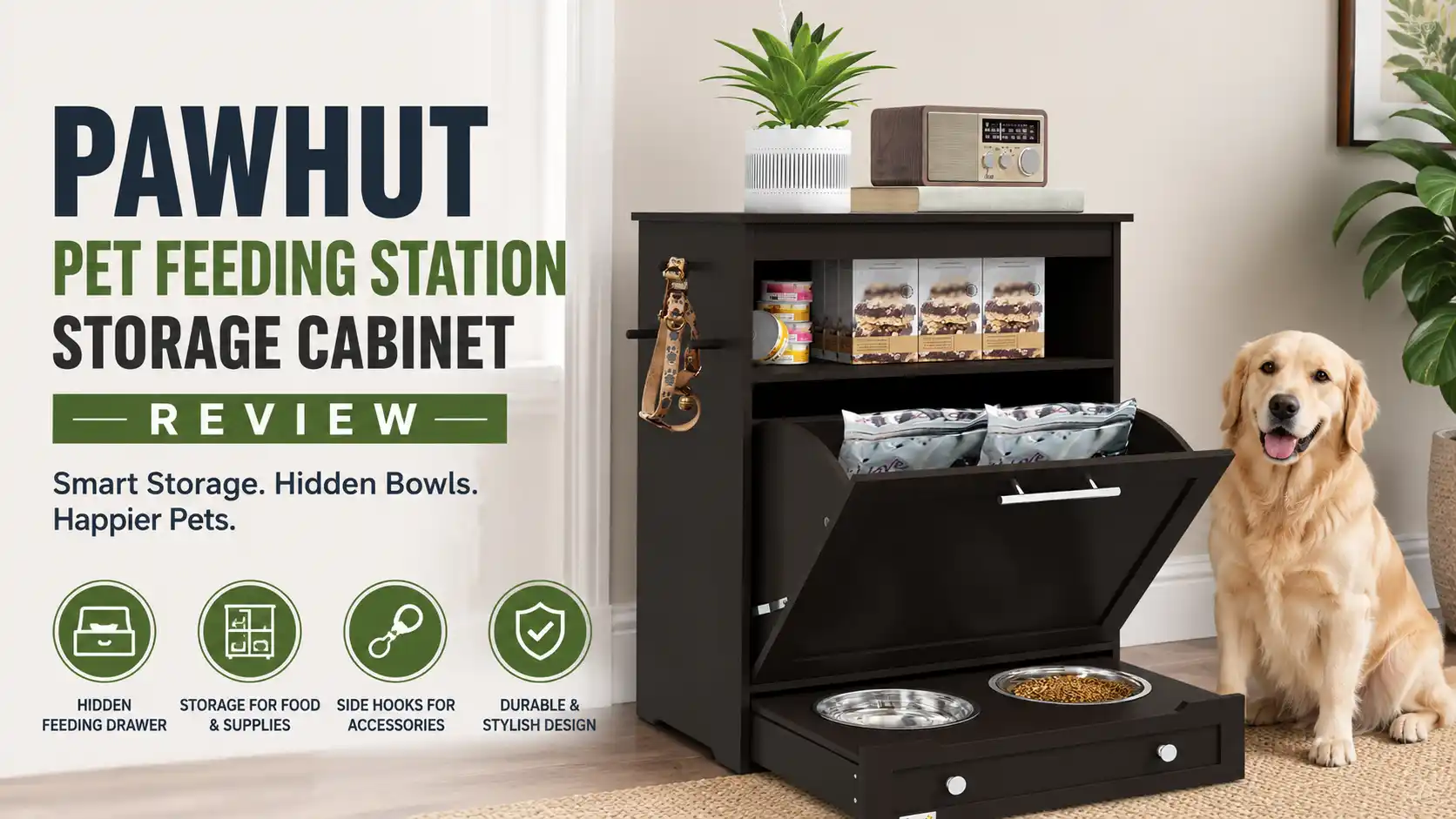
A furniture-grade feeding station that tucks your dog’s bowls out of sight and corrals all their supplies into one tidy cabinet.
Introduction
If you share your home with a dog, you know the quiet chaos that accumulates around the feeding area: a bag of kibble propped against the wall, leashes draped over a chair, the occasional treat pouch on the counter, and two bowls sitting in the middle of the floor between meals. It works, but it doesn’t look like anything you’d choose to live with. The PawHut Pet Feeder Station Storage Cabinet is built around a simple idea — consolidate everything related to your pet into one spot, and keep the bowls hidden when they’re not in use.
The concept isn’t entirely new, but PawHut’s execution leans heavily on home-decor sensibility. The cabinet is sized and styled to pass as a side table or end table, which means it can live in a living room, office, or bedroom without announcing itself as pet furniture. The brown finish in this variant fits into most warm wood-tone interiors, and the clean lines avoid the plastic, utilitarian look common in basic elevated bowl stands. The central question for any buyer is whether the storage and aesthetics justify the price tag over a simpler bowl stand — and the answer depends heavily on how much clutter you’re currently managing.
PawHut (by Aosom)
Brown (also available in White, Gray, Black)
24″ L x 14″ W x 32.25″ H
MDF board
7″ diameter x 3″ H
50.7 oz per bowl
19″ L x 9.25″ W x 9.5″ H
22″ L x 12.75″ W x 6″ H
44 lbs (countertop), 22 lbs (compartment), 22 lbs (cabinet), 11 lbs (bowl)
3 hooks for leashes and accessories
Yes
Medium dogs
Key Features
Pull-Out Drawer with Hidden Bowls
The design centerpiece is a bottom drawer that slides out to reveal two feeding bowls, then slides back in to conceal them completely. Between meals, there’s no visible bowl on the floor — just a clean cabinet base. This is functionally useful if you have guests, small children who trip over things, or simply prefer a tidier space. Each bowl holds 50.7 oz, which is a reasonable capacity for a medium dog’s meal and a full serving of water. The bowls are removable for washing, which is the minimum you’d want from any feeding setup. One thing to keep in mind: the drawer-out motion is the only feeding configuration, so dogs that eat enthusiastically may push the drawer while eating. This isn’t a dealbreaker, but it’s worth monitoring with more energetic feeders.
Multi-Zone Storage Cabinet
Above the bowl drawer, the cabinet offers three distinct storage zones. The enclosed lower cabinet — approximately 19″ wide x 9.25″ deep x 9.5″ tall — is sized to accommodate a standard-sized bag of dry dog food, though very large bags may not fit. An open middle compartment provides shelf space for cans, accessories, or folded items like a dog jacket or bandana. The countertop surface adds another flat area that can hold a small plant, a pet photo, or everyday items, and it holds up to 44 lbs. The practical value here is real: most dog owners have supplies spread across multiple rooms, and having a single place for food, treats, and extras reduces the mental overhead of daily pet care.
Side Hooks for Leashes and Gear
Three hooks mounted on the side of the cabinet provide a dedicated spot for leashes, harnesses, or collars. For dog owners who find themselves hunting for the leash every time a walk comes around, this single feature can be unexpectedly useful day to day. The hooks are load-bearing within reason — they’re designed for hanging soft gear, not heavy equipment — and they keep frequently used items at arm’s reach next to the door or in the entry area where the cabinet is likely to live.
Design and Build Quality
The cabinet is constructed from MDF board, which is the standard material at this price point for furniture-style pet products. MDF gives the cabinet its smooth, paintable surface and contributes to the clean, furniture-like appearance. The tradeoff is well-known: MDF is heavier than particle board and looks good when new, but it does not handle prolonged moisture exposure or hard impacts as well as solid wood. For a pet feeding station that sits indoors in a dry area, this is generally acceptable. Where it becomes a concern is if water splashes consistently around the bowl area and soaks into the base over time. Placing a silicone mat under the drawer when it’s extended is a sensible precaution that many buyers add.
At 32.25 inches tall, the cabinet functions as a genuine side table, which is an intentional design goal. The brown finish photographs warmer than it sometimes reads in person — reviewers describe it as a medium walnut-adjacent tone that pairs well with mid-century and transitional furniture. The overall silhouette is upright and rectangular without being boxy, and the drawer-and-cabinet proportion looks balanced. Assembly is required, and the process has been described as straightforward with included hardware and an instruction manual. Most buyers complete it in under an hour. The finished unit is solid enough that it doesn’t wobble under normal use, though it should be noted that MDF furniture of this style is not designed to be moved frequently once assembled.
Performance
As a functional feeding station, this cabinet performs its core jobs adequately. The pull-out drawer works smoothly when the cabinet is on a level surface, and the 50.7 oz bowl capacity suits medium-sized breeds without requiring multiple refills per day. The storage compartments are genuinely useful, not afterthoughts — the enclosed cabinet in particular is large enough to store a meaningful supply of food, which is the item most buyers are trying to get off the floor or out of view.
The most meaningful limitation in daily performance is the drawer mechanism itself. Dogs that eat quickly or push aggressively at their bowls can nudge the drawer back in while feeding. This is an inherent design constraint of the pull-out format rather than a manufacturing defect, but it is something buyers with active eaters should think about before purchasing. The cabinet is also sized specifically for medium dogs — it’s not a great match for large breeds that need a higher bowl elevation, and small dogs may find the bowl height awkward for comfortable drinking.
The MDF surface wipes clean easily, which is a practical benefit given that pet feeding areas tend to accumulate food residue and water drops. The side hooks perform exactly as expected: they hold leashes without strain and keep them accessible. There are no reports of hooks failing under normal use.
Ease of Use
Day-to-day interaction with this cabinet is simple. Pull the drawer, fill the bowls, push the drawer back in after meals. The bowls lift out cleanly for washing, which takes seconds. Stocking the storage cabinet and open compartment is intuitive, and the hooks require no setup after assembly.
Assembly is where some buyers put in more effort. The cabinet arrives flat-packed, and while PawHut includes instructions and hardware, MDF furniture assembly can be finicky if panels aren’t lined up precisely before screws are driven. Rushing the process tends to produce misaligned doors or slight gaps in the drawer fit. Taking it slowly and following the manual step-by-step is strongly recommended. Once assembled correctly, the cabinet doesn’t require ongoing adjustments.
One genuine ease-of-use gap: the bowl drawer doesn’t lock in the open position. If the cabinet is on a slightly uneven floor, or if an enthusiastic dog nudges it, the drawer can close unexpectedly during a meal. Most buyers find this manageable, but it’s something to be aware of on imperfectly level surfaces.
How It Compares to Similar Products
The PawHut feeder station occupies a specific niche: mid-range furniture-style feeding cabinets that prioritize aesthetics and storage alongside the functional feeding role. A basic elevated bowl stand — the simple two-bowl-on-a-raised-platform variety — costs significantly less, often between $20 and $50, and performs the feeding function adequately. The PawHut is not competing with that category. It’s competing with products like the HOOBRO Dog Feeding Station with Storage and the Tangkula Pet Feeder Station, which offer similar pull-out bowl and storage cabinet combinations at comparable price points.
Against those direct competitors, PawHut’s strengths are its clean exterior styling and the three-zone storage layout. The HOOBRO tends to have a sliding drawer design that some buyers find easier to use with active dogs, while the Tangkula version offers a slightly larger interior cabinet in some configurations. If bowl stability during feeding is your top priority, the HOOBRO with its sliding drawer design is worth comparing directly. If the furniture-style appearance and the open middle compartment matter more, PawHut holds its own.
The HAPPAWS feeding station is a notable alternative that includes stainless steel bowls, which are more durable and hygienic than the standard bowls included with many cabinet feeders. If bowl material is a concern, the HAPPAWS or an aftermarket stainless set is worth considering.
Pros & Cons
Pros
- Hidden bowl drawer keeps the feeding area visually clean between meals — a genuine differentiator from basic elevated stands.
- Three-zone storage (enclosed cabinet, open shelf, countertop) consolidates most pet supplies in one place effectively.
- Side hooks for leashes add practical daily value beyond the feeding function.
- Cabinet height and styling work as an actual end table or side table in living spaces.
Cons
- The bowl drawer has no locking mechanism in the open position, so enthusiastic dogs can accidentally push it closed mid-meal.
- MDF construction is moisture-sensitive; water spills around the bowl area can cause damage if not wiped promptly and consistently.
- Size and bowl height are optimized for medium dogs — large breeds and small dogs are not well served by this cabinet’s proportions.
- The enclosed cabinet interior, at 9.5 inches tall, won’t accommodate very large bags of kibble, limiting practical food storage for bigger dogs.
Who Should Buy This Product
This cabinet makes the most sense for dog owners with medium-sized breeds who care about the visual presentation of their home and want to reduce the clutter around their pet’s feeding area. If you currently have bowls sitting on the floor all day, a leash draped over something, and food stored in a separate location — and that arrangement bothers you — this cabinet directly solves all three problems. It also makes a reasonable choice for people who want to use the cabinet in a visible room like a living room or home office, where pet furniture that blends into the decor is a real priority.
Buyers who live in smaller spaces and need to free up floor area will also benefit from the vertical storage design. Having food, treats, and accessories stacked vertically rather than spread across a shelf or floor takes up less footprint than the scattered alternative.
Who Should Avoid This Product
Large dog owners should look elsewhere. The bowl height and capacity here are calibrated for medium breeds, and large dogs that need elevated bowls at a comfortable height will not be well-served by this cabinet’s proportions. There are dedicated large-breed elevated feeders with storage — PawHut itself makes one, as do several competitors — that are more appropriate. Similarly, owners of small dogs or cats who want an elevated feeder would be better served by a smaller, lower-profile option rather than a 32-inch-tall cabinet.
Anyone with a very active or pushy eater who reliably shoves things around during meals should consider a feeding station with a locking drawer or a fixed bowl platform rather than the pull-out mechanism. And buyers who prioritize long-term durability in humid or splash-prone environments — say, near a dog door that sees rain — would be better served by a product with a moisture-resistant or solid wood build.
Frequently Asked Questions
What size dog is this cabinet designed for?
PawHut specifies this feeder station for medium-sized dogs. The bowl height and capacity are calibrated for that size range. Large breeds will likely find the bowl position too low for comfortable elevated feeding, and very small dogs or cats may struggle with the height. If you have a large dog, look for PawHut’s large-breed elevated feeder or a comparable product from another brand designed for bigger animals.
Will a standard 30- or 40-pound bag of dog food fit in the enclosed cabinet?
The enclosed cabinet interior measures approximately 19″ L x 9.25″ W x 9.5″ H. A standard 30-pound bag of most kibble brands is taller than 9.5 inches, so it won’t fit upright. Smaller bags — typically under 20 to 25 pounds depending on the brand’s packaging dimensions — are more likely to fit. Many buyers store a portion of a larger bag in the cabinet and keep the bulk bag in a pantry or storage area.
Are the bowls dishwasher safe?
The product listing and manufacturer specifications do not confirm dishwasher compatibility for the included bowls. Given that the bowls appear to be standard coated or plastic-composite construction, hand washing is the safest approach. If dishwasher-safe bowls are a priority, aftermarket stainless steel bowls of the same diameter (7 inches) can be substituted.
Does the bowl drawer stay open on its own while the dog is eating?
The drawer does not have a built-in locking mechanism in the open position. On most level surfaces it stays open during a normal feeding session, but a dog that pushes energetically at the bowls can inadvertently slide the drawer back in. Some owners address this by placing a small door stop or wedge behind the drawer while feeding. This is worth factoring in if you have a particularly active eater.
How difficult is assembly, and roughly how long does it take?
Assembly is rated as manageable for most people with basic tool familiarity — a screwdriver is the primary tool needed, and hardware is included. Most buyers report completing assembly in 45 minutes to an hour and a half. The main caution is to align panels carefully before tightening any screws, as rushing tends to produce slightly crooked doors or a drawer that doesn’t slide evenly. Following the manual step-by-step and having a second person hold panels in place during assembly makes the process noticeably easier.
Final Verdict
The PawHut Pet Feeder Station Storage Cabinet does what it sets out to do: it clears the visual clutter of a dog’s feeding area, consolidates supplies into a single cabinet, and looks good enough to live in a room you actually spend time in. Those goals are worth something real, and for medium-dog owners who care about home organization and aesthetics, the value proposition is credible.
The limitations are genuine, not minor. MDF material requires more care than solid wood in spill-prone areas, the drawer’s lack of a locking mechanism is an ongoing inconvenience for active eaters, and the cabinet is strictly sized for medium breeds. At around $150, this is not an impulse buy — it’s a considered home-organization purchase that works well when the fit is right and underdelivers when it isn’t. If you have a medium dog, a home aesthetic worth protecting, and a cluster of supplies that need a permanent home, this cabinet earns its place. Otherwise, a simpler elevated stand or a larger-capacity alternative is likely the better call.